
REVIEW · WADI RUM DESERT TOURS
Full Day Jeep Tour and Overnight in Wadi Rum
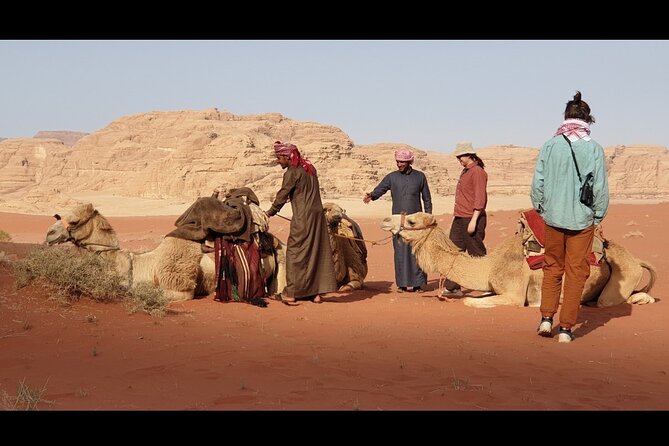
Wadi Rum is the kind of place silence has shape. This full-day Jeep tour with an overnight stay in a Bedouin-style camp lets you rack up classic sights like Lawrence’s Spring, towering canyons, and rock bridges, then sleep under the stars without building a plan. I like that the day is organized around real driving routes and short walks, so you see a lot without feeling rushed. One thing to keep in mind is that the Wadi Rum Protected Area entry fee (5 JD) is not included and is paid on site.
Two big wins for me: the small group size (capped at 12) and the included meals (lunch, dinner, and breakfast), which makes the overnight feel seamless. The camp setup also sounds intentionally low-key and personal, and the guides you’ll meet, including Salem and his team, focus on making things smooth from start to finish.
The main drawback is comfort depends on the season. Camp tents can get very hot if they are closed up all day, so plan on using the tent openings, windows, and door time the way your host suggests. Also, you should expect a desert routine, not a hotel one.
In This Review
- Key points worth knowing
- How the full-day Jeep loop plus overnight changes the experience
- Meeting your guide in Wadi Rum village, then letting the route run
- Lawrence’s Spring and the pipeline hike: where the views start early
- Red sand dunes and 360-degree desert math
- Khazali Canyon: the rock art stop you will remember later
- Little Bridge and Lawrence’s House: two photo stops with different vibes
- Lunch by fire, then Mushroom Rock and the viewpoint rhythm
- Abu Khasaba Canyon plus sand boarding: the day’s easiest adventure mix
- Um Frouth arch, Chicken Rock, and that soft-sand dune detail
- Settling into Um Sabatah camp: sunset tea, dinner fire, and stars
- What you should pack and how to handle desert conditions
- Price and value: what $125 includes, and what costs extra
- Who this tour fits best, and who might want a different style
- Should you book this full-day Jeep and overnight in Wadi Rum?
- FAQ
- How long is the full-day Jeep tour with overnight in Wadi Rum?
- Where do I meet, and where do I return to?
- What meals are included?
- Is the Wadi Rum Protected Area entry fee included?
- What is the group size?
- Is there a free cancellation window?
Key points worth knowing
- Capped at 12 travelers, so the pace stays relaxed and you are not stuck with a massive group.
- Meals included (lunch, dinner, breakfast), so you only pay the protected area fee separately.
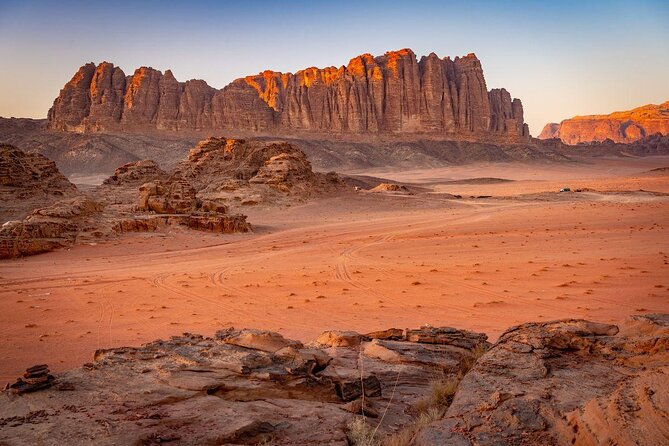
- A real mix of short hikes and viewpoints, from Lawrence’s Spring walkups to canyon passes.
- Sunset and stars from the camp area, with Bedouin tea and an evening fire routine.
- One clear day-night plan, meeting in Wadi Rum village and returning to the same meeting point.
More of Wadi Rum, from two hours to two nights
How the full-day Jeep loop plus overnight changes the experience
Wadi Rum works best when you do more than just rush through the highlights. The day-night format gives you two totally different atmospheres. During daylight, you are climbing on red sand and reading the rock surfaces in your own way. At night, everything quiets down, and the sky becomes the main event.
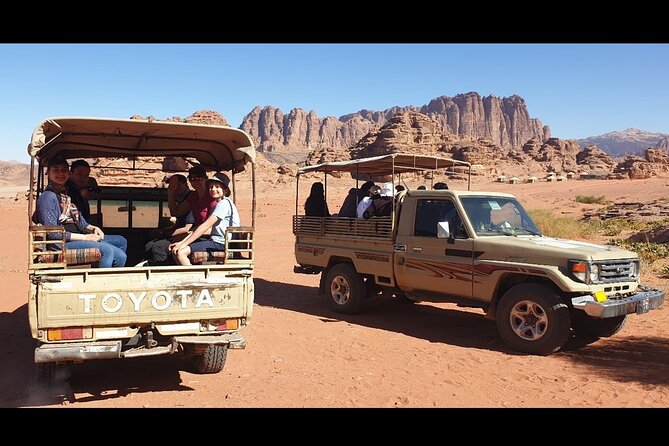
This tour is built for people who want variety without logistics headaches. You meet up in the Wadi Rum village area, then the jeeps take over the driving. You are not trying to negotiate rides between scattered viewpoints, and you are not stuck guessing how long each stop will take. The itinerary also strings together nearby geology, so the day flows.
And because you end at a camp deep in the desert, you do not have to scramble for your next transfer after dinner. That matters more than it sounds. In Wadi Rum, one small delay can knock you out of sunset timing, and sunset is a major part of why you came.
Meeting your guide in Wadi Rum village, then letting the route run
The plan starts at 9:00 am at Wadi Rum Rest House in Wadi Rum village, and the tour ends back at the same meeting point. Your day includes a return transfer to Wadi Rum village, which is helpful if you are staying near Aqaba and want this experience to connect cleanly to the rest of your trip.
You will likely meet the people behind Real Bedouin Experience Tours & Camp. Names that come up often include Salem, along with team members such as Frances and Saleh, and sometimes Francis. Even when your day turns into a whirlwind of stops, these guides try to keep the human part of the trip calm, from clear pre-trip communication to on-the-ground instructions at each walk.
If you like having your bearings straight before you arrive, that is a real advantage. One common theme in feedback is that communication is prompt and detailed, with practical instructions so you do not feel like you are wandering around trying to match the right jeep.
Lawrence’s Spring and the pipeline hike: where the views start early
The first stop is Lawrence’s Spring (also called Ain Abu Aineh). You start in the Wadi Rum village area and then head out by jeep. The spring is reached by a short walk up toward Jebel Rum, and you can follow a pipeline to the water source.
This is not just a pretty pause. It is a glimpse into how water and life work in a desert. The pipeline feeds water into a long trough where camels drink. Nearby, there is a large rock with ancient Nabatean hieroglyphs recorded around 300 B.C.
What makes this stop especially good is the optional feel of it. You can treat it as a quick viewpoint, or if you feel like it, you can climb a bit more for stronger panoramas. Either way, you get that early sense of scale, the kind that makes the rest of the day land harder.
One practical note: the spring hike is short but it is still uphill. If your legs are not great with stairs and slopes, just pace yourself and take breaks before you feel winded.
Red sand dunes and 360-degree desert math
Next up is the Red Sand Dunes stop, where you drive to a high dune of soft red sand. The classic move here is climbing to the top for 360-degree views across the open desert, framed by three mountains: Jebel Rum, Um Ishrin, and Jebel Khazali.
This stop is where you get your first real reading of Wadi Rum’s geometry. From up there, it becomes easier to understand why the rock formations look like they do, and why the canyons catch light in such sharp patterns.
The dune climb is not technically described as difficult, but you should treat it as real effort. Soft sand slows your steps, especially under strong sun. If you want photos from the top, plan to go calmly, not sprint up and hope for the best.
Other jeep runs across the sand
- Full-Day Jeep Tour and Sleeping in cave Night Under the Stars
★ 5.0 · 145 reviews - Full Day Jeep Tour with Overnight in beduin Camp Stay! (All Meals Included)
★ 5.0 · 136 reviews - 4×4 Full-Day Desert Tour
★ 5.0 · 136 reviews - Full Day Jeep Tour & Traditional Lunch – Wadi Rum Desert Highlights
★ 5.0 · 110 reviews - Full Day Desert Tour, Jeep & Hiking
★ 5.0 · 98 reviews
Khazali Canyon: the rock art stop you will remember later
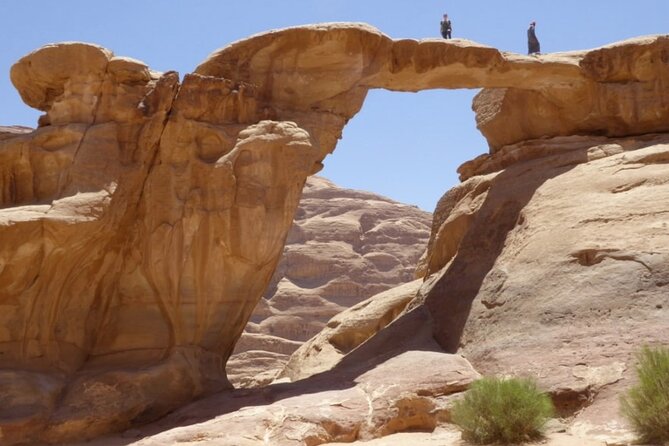
Jebel Khazali is where the tour gets more interesting for people who like markings and layers in the landscape. You stop near Khazali Canyon and walk to a high-walled split where sunlight filters down between canyon walls. The light can show multiple shades of pink, brown, and grey.
The canyon also includes rock pools about 20 meters in, usually dry in summer and filling after rain in winter months. Even if you are visiting in a dry season, the canyon still feels like a natural doorway into a different version of Wadi Rum.
Why this stop is a standout: it is famous for rock art and inscriptions created over centuries. You can find Thamudic, Arab, and Nabatean carvings, plus petroglyphs of humans, animals, and footprints. There is also Kufic writing, an early Arabic script, inscribed on the walls.
If you are the type who likes to look slowly, take extra time here. This is one of those places where you can keep noticing details long after everyone else has moved on.
Little Bridge and Lawrence’s House: two photo stops with different vibes
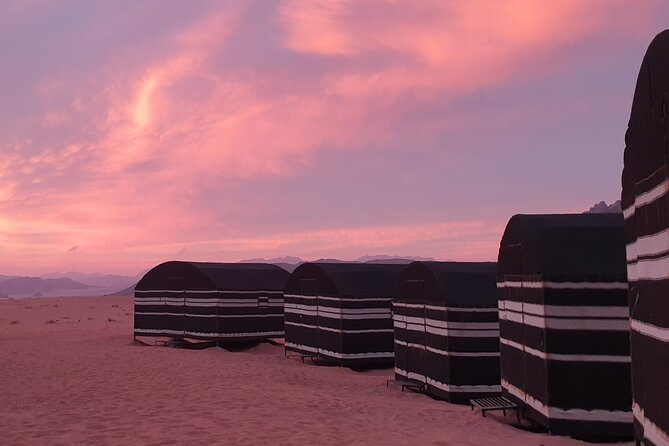
After Khazali Canyon, you head to Little Bridge, also known as Little Arch. This is an easy walk to a rock bridge, and it is especially good for photographs because you can stand on the center of the bridge.
A small but useful detail: the bridge is in the desert, not back near Wadi Rum village. That matters because it confirms you are really still in the remote loop, not bouncing back to the village area for a quick stop.
Then the day continues toward Lawrence’s House, about 10 minutes’ drive from Little Bridge, far into the desert. The site is thought to have been built on top of Nabatean ruins, and there is a small Nabatean inscription nearby. There is also a story linked to T. E. Lawrence, sometimes called Lawrence of Arabia, that he stayed here while living with Bedouin groups in the Wadi Rum area, though the exact connection is not fully known.
This stop is less about climbing and more about imagining the place. Stand and look across the valley, and you can see why a lookout point like this would matter strategically.
Lunch by fire, then Mushroom Rock and the viewpoint rhythm
In the middle of the day, you pause for lunch inside the protected area. The guide sets up food fresh, including galayet bandora cooked over a fire. You are served a simple Bedouin-style meal with items like hummus, tomatoes and cucumbers, bread, and more.
Lunch is not just refueling. It is your recovery checkpoint in a day full of sun and moving sand. The timing also helps you dodge some of the harsher energy drain, since you are eating when the day is already busy enough to feel demanding.
After lunch, you head to Mushroom Rock, a formation that looks like a mushroom and is perfect for photos. The fun here is not just seeing it, but trying the perspective tricks, like posing as if you are holding it up. It sounds silly. It works.
Then comes the viewpoint rhythm shift at Um Frouth’s area via Burdah Rock Bridge. You stop near Burdah Rock Bridge, which towers about 300 meters above the valley floor. On this full-day loop, you view the arch from the other side from down low in the valley. Importantly, you do not climb up to the top on this itinerary, so it is more about the view than the extra effort.
Abu Khasaba Canyon plus sand boarding: the day’s easiest adventure mix
One of the best “doable for most people” segments is Abu Khasaba Canyon. You arrive by jeep, the jeep is parked, and the guide shows you the canyon entrance. Then the jeeps go around the mountain to wait at the other end while you hike through.
The hike is described as easy with a short rocky section in the middle. Typical time is around 35 minutes, and it can be less for very fit hikers. The key advice is to take your time and enjoy the cooler feel and the trees you might notice inside the canyon.
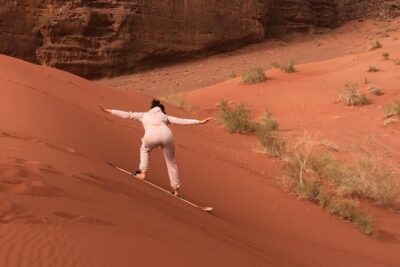
When you come out of the canyon, you reach a sand dune that is good for sand boarding. A sand board is provided at no charge. This is one of those moments where you get movement and fun without feeling like you signed up for a hardcore activity.
If you tend to get nervous on uneven footing, Abu Khasaba is a good chance to build confidence. You are not expected to race.
Um Frouth arch, Chicken Rock, and that soft-sand dune detail
Next you visit Um Frouth Rock Bridge. This is in the white desert zone, and from where you view it, the arch can look almost invisible due to the similar-colored rocks around it. That contrast makes the moment when you spot it feel a little like a trick of the eye.
On most days, people can climb to the top and even walk across the bridge. Even if you do not climb, the arch is still worth seeing because of how it changes against the desert tones.
After that is Chicken Rock, a formation that resembles a chicken from one direction, and sometimes also a cow from another. It is one of those whimsical stops that breaks up the serious geology and gives you a playful photo break.
Nearby is a large free-standing dune made of very soft sand. The wind creates ripples and designs, and you can sometimes see tracks of small creatures like beetles and lizards. That detail matters because it adds texture to your photos beyond just a wide red or white horizon.
Settling into Um Sabatah camp: sunset tea, dinner fire, and stars
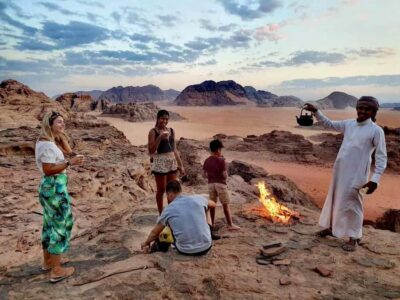
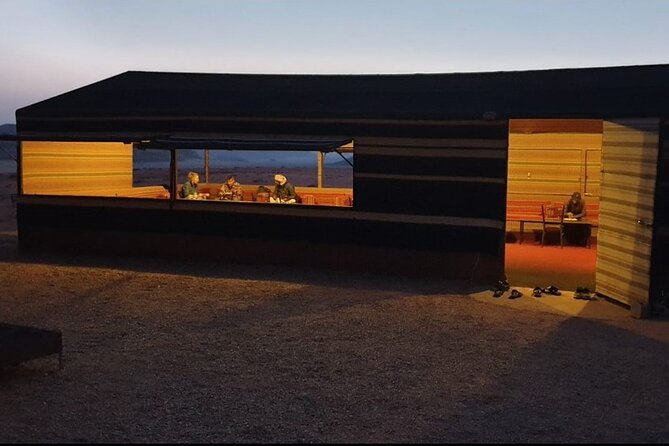
The day ends at camp with enough time for sunset viewing. You drive to the camp in the Um Sabatah area, which is known for spectacular sunsets. The camp is set up so you can relax with Bedouin tea in a dining tent, then sit out on the sands for views. There is also the option to climb a small mountain behind the camp.
After dinner, the evening routine shifts into a quieter, slower mode. You gather on comfortable mats around a fire in the Bedouin tent in winter, or you sit outside under star-filled skies in summer. Either way, the idea is the same, you get time to look up and actually see the night sky, not just pass through it.
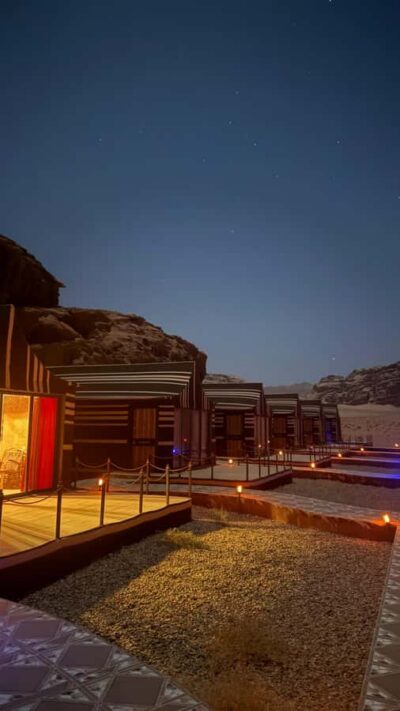
Sleeping is in a Bedouin-style tent. A common theme is that tents are comfortable once you manage them properly. Your host also clarifies an important practical point: tents can get very hot when closed up all day. If you want a better temperature, you will want to open the door and windows, using your time at the right moments.
Season matters here. In January, expect cold in the desert, but also clearer stars at night. So bring a plan for layered warmth, not just one outfit.
What you should pack and how to handle desert conditions
This tour includes water and warm drinks, and it includes a towel. Still, you should plan like you are spending long hours outside in changing conditions.
Bring a hat and sunscreen. The day includes dunes and canyon walks in open desert sun, and you will be outside for long stretches.
Wear shoes with grip. Some stops include rocky bits, and sand footing can get tricky.
Pack layers for night. Even if you are focused on sunset and stars, desert nights can feel colder quickly.
Plan for tent airflow. If your tour lands in hot weather, you will want to manage the door and windows the way your host suggests.
Also, keep expectations realistic. This is a desert camp experience, not a luxury lodge. The goal is comfort enough to sleep and eat well, plus a calm, genuine setting to enjoy the night.
Price and value: what $125 includes, and what costs extra
At $125 per person, you are paying for a lot more than a viewpoint ticket. You get the full-day Jeep tour plus an overnight stay, with lunch, dinner, and breakfast included. The tour also provides coffee and/or tea, bottled water, and a towel. You also get return transfer to Wadi Rum village, which helps you avoid a second set of arrangements.
The value gap to understand is the Wadi Rum Protected Area entry fee, which is 5 JD and is paid at the Wadi Rum Visitor Center, or you can show Jordan Pass if you have it. In practice, this is the one extra line item you should budget for before you go.
The other value lever is the group cap at 12 travelers. Smaller groups usually mean less waiting, and it often means your guide can adjust pace when someone wants a slower climb or a longer look.
If you are comparing it to other Jordan add-ons, this is one of the few experiences that includes both the movement of a full day tour and the payoff of a real night under the stars.
Who this tour fits best, and who might want a different style
This itinerary fits best if you want:
- A full day of classic Wadi Rum stops with short walks instead of hours of hiking
- A real overnight in the desert camp area, with sunset and stargazing
- A small group feel and a guide who is easy to communicate with, like Salem and Frances
It might be less ideal if you:
- Want to spend most of the day hiking long distances, because this is built around jeep stops and short to moderate walks
- Get uncomfortable with basic camp routines, especially if you need hotel-like temperature control
- Are sensitive to hot afternoons in summer tents unless you are comfortable using the tent openings for airflow
If you are traveling with kids or anyone with limited mobility, the short-walk segments can still be doable, but you will want to be honest about foot travel. The canyon walks and dune climbs are not built for wheelchairs.
Should you book this full-day Jeep and overnight in Wadi Rum?
If your goal is Wadi Rum in a single shot, with maximum variety, I think this is a strong pick. The day is packed but not chaotic, because the stops are sequenced to keep you in motion while still giving time for viewpoints and photos. The overnight camp turns the whole trip from sightseeing into a night you will actually remember, especially if you care about sunsets and a star field that feels bigger than your phone camera.
Book it if you like the idea of a structured route with real natural highlights, plus included meals and a camp experience run by a team that communicates clearly before you arrive. Skip it or consider another option if you want luxury comforts or you do not want to manage desert tent temperature and walking time.
FAQ
How long is the full-day Jeep tour with overnight in Wadi Rum?
The experience runs about 23 hours and 30 minutes, starting at 9:00 am and ending back at the same meeting point.
Where do I meet, and where do I return to?
You meet at Wadi Rum Rest House in Wadi Rum village, and the activity ends back at the meeting point.
What meals are included?
Lunch, dinner, and breakfast are included, along with coffee and/or tea, plus bottled water.
Is the Wadi Rum Protected Area entry fee included?
No. The Wadi Rum Protected Area entry fee is at your expense. It is 5 JD, paid at the Wadi Rum Visitor Center or handled with Jordan Pass.
What is the group size?
The tour is capped at a maximum of 12 travelers.
Is there a free cancellation window?
Yes. You can cancel up to 24 hours in advance for a full refund. Changes made less than 24 hours before the start time are not accepted.
Nights Under Canvas
More Jeep Days on the Sand
Still in Wadi Rum
Fresh off the review desk
- Wadi Rum Classic 4-Hour Jeep Safari★ 5.0 · 3 reviews
- WADI RUM: ALL DAY JEEP TOUR with overnight and full meals★ 5.0 · 3 reviews
- Wadi Rum 4-Hour Sunset Tour – Wadi Rum Desert Highlights★ 5.0 · 3 reviews
- 1 Day & 1 Night | Stay & Jeep + Camel Tour in Wadi Rum | Magic Bedouin Star★ 4.5 · 3 reviews
- Transfer from Aqaba Airport to Petra★ 5.0 · 3 reviews
- Petra Day Tour from Aqaba Port (Shore Excursion Petra) – JHT★ 5.0 · 3 reviews
Wadi Rum Desert Tours, compared.
 ★ 4.9Petra, Wadi Rum, and Dead Sea 2-Day Tour1,173 reviews
 ★ 5.02-Day Tour: Petra, Wadi Rum, and Dead Sea from AmmanFrom $2491,141 reviews
 ★ 4.9Petra & Wadi Rum Private or group Day TourFrom $126750 reviews
 ★ 5.0Petra and Wadi rum Full day TourFrom $99538 reviews
 ★ 5.02-Day Petra, Wadi Rum and Dead Sea Tour from AmmanFrom $275467 reviews
 ★ 5.03-Day Private Tour from Amman: Petra, Wadi Rum, Dana, Aqaba, and Dead SeaFrom $349425 reviews
 ★ 5.0Wadi Rum Full Day Jeep Tour + Overnight & Dinner in Bedouin CampFrom $107368 reviews
 ★ 4.9Petra & Wadi Rum: Full Day Private Tour with Hotel PickupFrom $133310 reviews
Browse the lists this tour appears in